Tested & verified
Most of what’s on this site is a description of intended behavior. This page is different: it’s a running log of things the team actually measured, broke, or discovered by testing the real system against the real internet — including the times it didn’t work the first time.
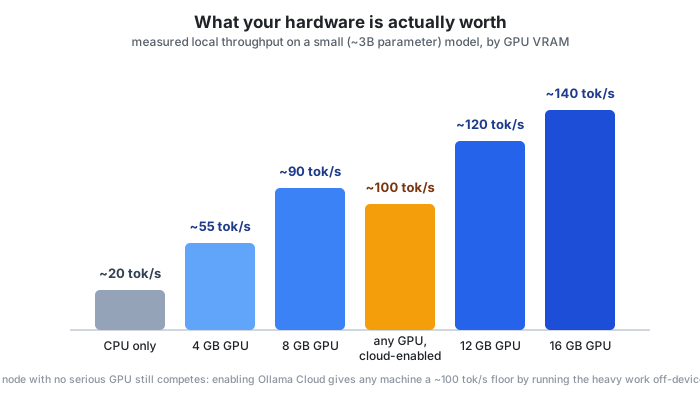
Real throughput, not a guess
TokenBroker’s Ollama Cloud capacity baseline (see capacity comparison) is not a number from a spec sheet. It came from a deliberately bounded, one-hour probe run against a real free-tier account: 664 real requests, zero rate-limit or quota errors, 367,728 real tokens generated. The published baseline (300,000 tokens/hour) is that result rounded down for a safety margin, not rounded up for a better-looking number.
Google AI Studio doesn’t offer the same option — as of this writing Google publishes no fixed rate-limit table for it at all (their own docs point you to a per-account dashboard instead), and the API returns no rate-limit headers to infer one from. So that baseline is explicitly labeled as an estimate, not a measurement, until a Google-side probe like the Ollama one exists. We’d rather tell you which numbers are which than round both to look equally authoritative.
What actually breaks a job, tested live
The network’s anti-farming quality gate isn’t theoretical — here’s a real example from testing the Google AI Studio integration:
A test job deliberately asked a worker for the shortest possible answer, on purpose, just to verify the whole path worked end to end. The worker claimed it, called Google’s real API, and got back exactly the trivial answer it asked for. The job was still marked failed — the response was real, but too short to count as genuine work.
That’s not a bug report — it’s the gate working exactly as designed. A follow-up job with a normal, realistic prompt went through cleanly in a few seconds on the same worker. We don’t publish the exact thresholds those gates check (length, timing, throughput, and response diversity, among others) — the same reason a bank doesn’t publish its exact fraud-detection rules. What we can tell you honestly: they’re tuned against real completions from real hardware, not guessed at, and they’re revisited whenever testing turns up a gap.
Known, tested request limits (so you don’t have to guess)
We deliberately pushed on the edges of the system — large prompts, batches of large jobs, oversized payloads — to find real limits rather than assume ones. These are consumer-facing request limits (the kind any API documents so you can build reliably against it), not the anti-abuse detection logic above:
| Limit | Value | What happens past it |
|---|---|---|
| Job payload size | 100,000 characters (raw request JSON) | 400 payload_too_large |
| Output tokens per job | 4,096 | Requests get capped, not rejected |
These aren’t arbitrary — they came out of intentionally sending oversized and bulk requests during development and watching what needed a real limit versus what the system already handled gracefully.
A real bug we found and fixed
Early in mobile support, the Android worker’s cloud requests were getting a
bare 403 Forbidden from Ollama’s cloud API — with the exact same key,
headers, and body that worked perfectly from every other client. The cause
turned out to be TLS fingerprinting: Android’s default HTTP client has a
distinctive low-level handshake signature that anti-bot systems can
recognize as non-browser scripted traffic and block before any
credential check even happens — completely independent of whether the
request itself was correct. Switching the mobile client to a networking
library with a standard, unflagged TLS signature (the same kind any real
mobile app uses) fixed it immediately.
We’re including this because it’s a good example of the gap between “the code looks right” and “the code works against the real internet” — and why this page exists instead of just a features list.
Re-checking the whole catalog
Catalogs rot quietly: a model can keep showing as “healthy” long after it stopped answering real requests, because a reachability ping isn’t an inference call. So we re-tested every hosted route with a real, tiny request and rebuilt the advertised list from what actually answered.
What that turned up, in plain terms:
- A large share of listed models didn’t answer at all. Many had been retired upstream or never existed under the listed name, and several more sat behind paid plans our free-tier routes don’t cover. Those were removed rather than left to fail for real users.
- Edge-GPU routes mostly held up. 23 of the 26 models on that route answered once a one-time vendor license was accepted for one of them. The other three need a paid upstream plan, so they aren’t advertised.
- Names can mislead. Searching the catalog by name made some model families look absent when they were actually served under a different prefix, which is why we check by actually calling models rather than searching names.
One lesson about the testing itself: our first pass probed many models at once against a shared proxy, and the burst produced false failures — at least one perfectly good model was flagged as missing. Re-running sequentially, with a retry before declaring a model gone, fixed it, and that’s now how we test.
The result is a shorter advertised list than before, on purpose. We’d rather promise less and have it work, then grow toward nearly every open model as access becomes sustainable.
What we found doesn’t work (yet)
Not every integration attempt succeeds, and we’d rather say so than quietly drop it:
- Structured outputs / JSON mode on Ollama Cloud: as of this writing,
Ollama’s cloud backend does not support structured/JSON-schema-constrained
outputs, confirmed directly against their own documentation. If your
workflow depends on guaranteed JSON shape, prompt for it explicitly and
validate on your side rather than relying on a
response_formatparameter against a cloud model. - Stale model names: providers retire model versions without much
warning. Before adding Google’s Gemini model to the catalog we caught two
already-retired names (
gemini-2.0-flash,gemini-1.5-flash) by testing live against the real API rather than trusting a reference table — the live model that replaced them is the one actually in the catalog today.
What’s worth taking away from this
None of this is meant as a warning label — it’s meant as evidence that the numbers elsewhere on this site (capacity baselines, quality gates, model names) are grounded in something more than a marketing deck. When we don’t know something for certain — like Google’s real rate limit — we say so instead of inventing a confident-sounding number.
See the full system breakdown for how these pieces fit together, or the FAQ for quick answers.