Overview
What problem does TokenBroker solve?
Open-weights models are incredible — but running them well is not for everyone. Big models need big GPUs most people don’t own. Small machines can only run small models, so you either compromise on quality or go rent a server. And the hosted APIs that solve that problem are fragmented: a different account, a different key, a different pricing scheme, a different rate limit for every provider you want to try. Want to compare five models for a project? That’s five signups, five keys, five bills.
TokenBroker collapses all of that into one account, funded by a different kind of infrastructure than the usual answer (a bigger data center):
- A catalog of hundreds of models, from lightweight 0.5B models that run on a laptop to 120B-class hosted models — curated, verified and priced, not a raw dump of everything that exists, and growing toward nearly every open model.
- A single API — OpenAI-compatible, so it works with the tools you already use (LangChain, Open WebUI, custom code, scripts) with a one-line change: point the base URL here instead.
- A compute network — instead of the operator buying more GPUs, contributors run a small worker on hardware they already own and earn credits for real work done. Capacity grows with the community, not with a budget line item — which is also why prices can stay honest instead of being padded to cover a data center lease.
The rest of this page is the mechanics. If you want the reasoning behind why it’s built this way instead of the obvious alternative, read Take back your compute first.
How a request flows
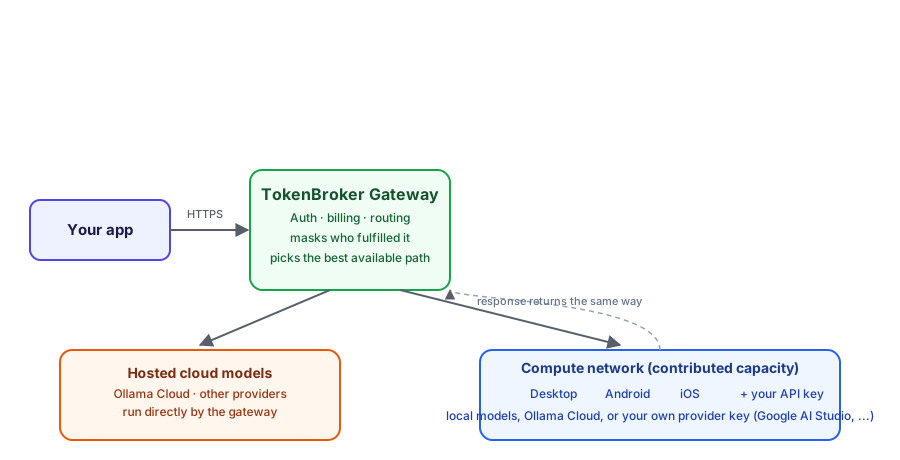
Every request lands on the gateway first. The gateway decides, per request, whether to answer it directly with a hosted cloud model or hand it to the compute network — and if the compute network, which of the many contributed workers is the right one. The response always travels back through the gateway the same way; you never see or need to know which machine (or whose) actually answered.
The public entry point is https://tokenbroker.hopto.org, which is delivered through Cloudflare’s edge network. That means:
- No port forwarding — the operator’s home network never exposes a port.
- No IP guessing — the domain is stable, even as the underlying tunnels rotate.
- Fast, cached, protected — Cloudflare sits in front of every request.
The three parts of the system
1. The website & dashboard
Sign up with email/password or Google, verify your email, and land in a dashboard where you can:
- Browse the model catalog with live pricing and descriptions.
- Create and manage API keys.
- Try models in the playground.
- Top up your wallet, buy a plan, or pay with a static Square link.
- Manage your worker node and watch its earnings and quality score.
- View usage, billing history, and request transcripts.
2. The API
A single, OpenAI-compatible endpoint accepts chat/completions,
completions, and embeddings requests. Authentication is a simple API key.
Billing is token-based, with predictable per-model pricing and daily caps you
can set per key. See the API reference.
3. The compute network
Instead of building one giant GPU farm, TokenBroker routes work to a network of volunteer nodes — the compute network:
- Nodes run a small, transparent worker: a desktop tray app (Windows), or a companion app on Android and iOS that relays jobs to cloud-hosted and external-provider models in the background.
- The worker advertises what it can run: its GPU, RAM, storage, and models — or, for GPU-free contributors, an Ollama Cloud sign-in or a personal external-provider key (Google AI Studio today).
- The gateway matches each request to the best available node — a node that already has the model, then a node with room to pull it, then a cloud fallback — never handing a node work it can’t actually do.
- Nodes earn credits for completed work, at a rate that depends on response quality and consistency (see Pricing & credits).
This is what keeps TokenBroker sustainable without needing a bigger budget: the more people contribute — hardware, a phone, or just a spare API key — the more capacity exists, and the cheaper access becomes for everyone already using it. See the full breakdown for exactly how a request picks its path, or Tested & verified for the real numbers behind that claim.
What TokenBroker is not
- It is not a training platform.
- It is not an anonymous darknet — accounts are real, payments are real, and abuse controls exist.
- It is not a code repository. This repository documents the service; the implementation stays private for security reasons.
Where to go next
Ready to try it? Getting started. Curious about the network? Compute network. Want every detail in one place? A full breakdown of the system. Want the real numbers, not marketing copy? Tested & verified. Want to know why any of this exists? Take back your compute.